Inquiry or Explicit Teaching? Why Science Needs Both
New research shows how guided exploration combines inquiry and explicit teaching to deepen science learning while preserving clarity and student agency.
Science teaching is often framed as a choice: let students discover ideas through inquiry, or teach the content explicitly.
That choice is too simple.
A newly published analysis in the International Journal of Science and Mathematics Education argues that some of the strongest science learning happens when teachers deliberately combine the two. Students explore a carefully framed phenomenon or problem, make their thinking visible, and then receive timely questions, explanations, modelling, and consolidation from the teacher.
The goal is not unguided discovery. Nor is it to explain everything before students have a reason to care. It is guided exploration: a purposeful movement between student sense-making and teacher expertise.
The problem with the inquiry versus explicit teaching debate
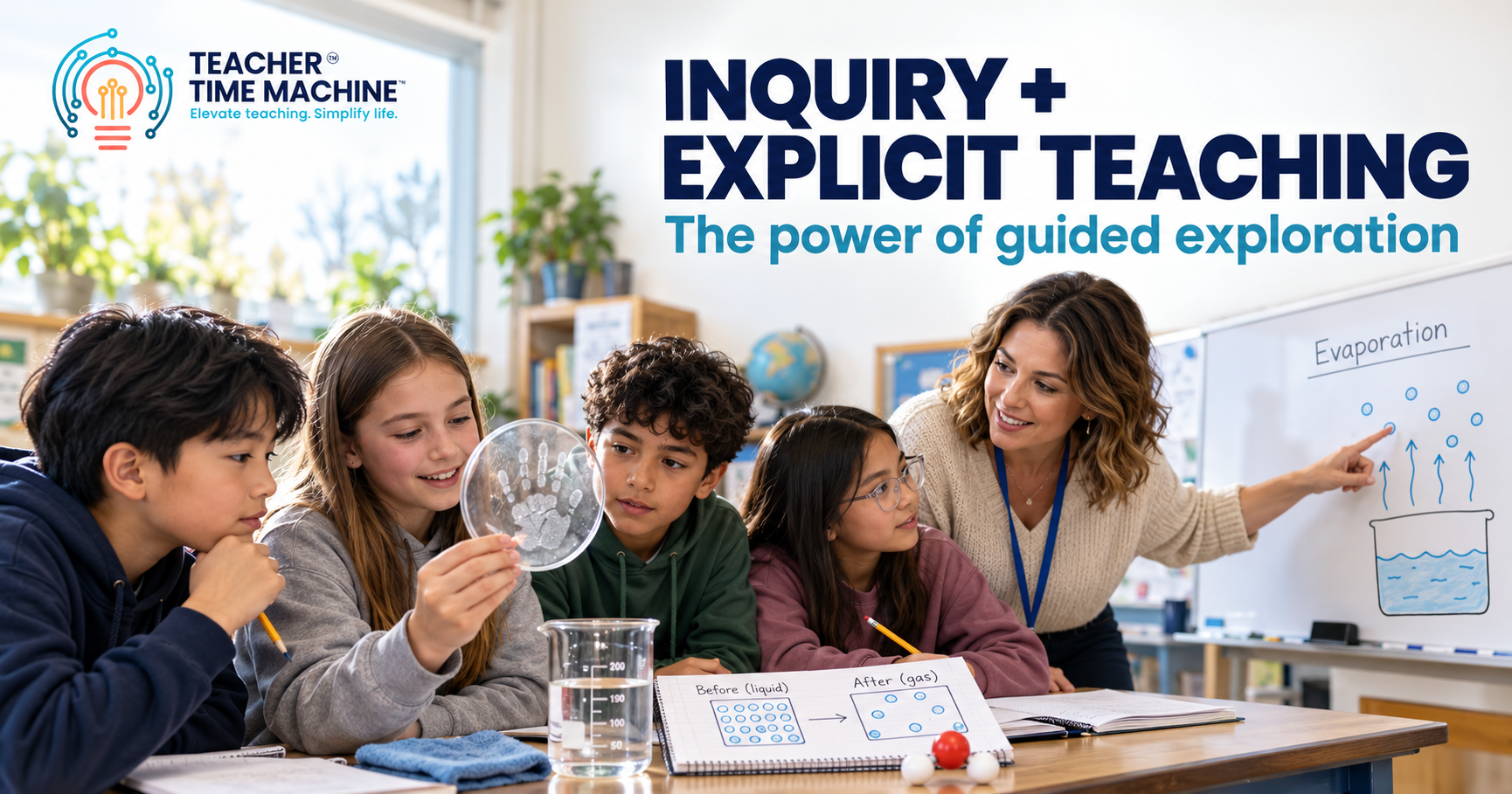
Consider a Grade 5 or 6 lesson about evaporation.
A teacher could begin by explaining particles, state changes, and water vapour. Students would receive accurate information in a clear sequence. But the explanation might never reveal what they currently believe happens when a puddle disappears.
At the other extreme, students could investigate evaporation with little direction and be expected to discover the particle model independently. That may produce interesting activity, but not necessarily a scientifically sound explanation.
Guided exploration takes a more productive route. The teacher introduces a phenomenon worth explaining, invites students to draw on their current understanding, and structures the task so their ideas become visible. The teacher then uses questions, representations, demonstrations, and explicit explanation to move the class toward the intended scientific understanding.
The exploration creates the need for the explanation. The explanation makes the exploration meaningful.
What the new research examined
The October 2026 paper by Saeed Salimpour, Vaughan Prain, and Russell Tytler reanalyzed three detailed science-classroom cases through a social-semiotic lens. In other words, the researchers examined how students developed scientific meaning through talk, diagrams, models, gestures, investigations, and other forms of representation.
Across the cases, teaching did not follow a simple “explore first, explain later” formula. Instead, instruction moved back and forth between:
- Student observation and idea generation
- Teacher framing and questioning
- Student-created models or representations
- Explicit introduction or confirmation of scientific ideas
- Whole-class discussion, refinement, and consensus
The amount and form of guidance changed with the students’ age, prior knowledge, the concept being taught, and the disciplinary practices the teacher wanted students to develop. The authors’ central point is that guidance is a design variable, not an all-or-nothing choice.
Guided exploration is not minimally guided discovery
This distinction matters.
In the classroom examples, teachers did not simply provide materials and step aside. They narrowed the problem space, activated relevant prior knowledge, posed carefully chosen questions, introduced models at strategic moments, and helped students evaluate competing explanations.
At the same time, they did not tightly prescribe every response. Students still had room to notice, propose, represent, test, revise, and explain.
In one evaporation sequence, students mapped where water could be found around their school, debated whether water was present in the air, suggested ways to gather evidence, and created visual representations of particle movement. The teachers guided discussion toward scientifically useful ideas and introduced or confirmed concepts when students needed them. Student work then became material for further teaching rather than an activity completed and set aside.
That is the heart of guided exploration: the teacher follows student thinking without surrendering the learning destination.
Five reasons exploration remains essential
The authors identify five reasons for retaining guided exploration within effective science teaching.
1. It strengthens motivation and agency
Students are more likely to invest intellectually when they are invited to make sense of something—not merely receive the finished explanation. A well-designed puzzle gives them a reason to ask questions, test possibilities, and revise their thinking.
2. It gives teachers formative evidence
Exploration reveals what students notice, understand, misunderstand, and can already do. Their questions, diagrams, models, and explanations provide evidence a teacher can use immediately. This makes exploration part of formative assessment. Its purpose is not only to engage students; it helps the teacher decide what to do next.
3. It connects everyday experience to scientific concepts
Many science ideas require students to reconsider how they understand familiar events. A disappearing wet handprint or changing puddle can create a productive gap between what students observe and what their current explanation can account for.
Explicit teaching is more meaningful when it helps students resolve a problem they have already encountered.
4. It helps students understand why scientific claims are credible
Students need more than the correct answer. They need opportunities to recognize the evidence and reasoning that support it. Guided exploration lets students encounter the basis for a scientific explanation before—or while—the teacher helps formalize it.
5. It develops the practices of science
Science learning also includes collaboration, testing ideas, using evidence, building models, and representing findings. Students develop these practices by participating in them with knowledgeable guidance, not by hearing about them in the abstract.
A practical five-part lesson sequence
The paper is conceptual rather than a prescriptive lesson template, but its analysis suggests a useful planning sequence.
1. Identify the intended learning
Begin with the curriculum outcome and the scientific understanding students should develop. Guided exploration still requires a clear destination. Ask: What should students understand or be able to explain by the end?
2. Choose a productive phenomenon or problem
Select an experience that makes the target concept necessary. The problem should be open enough to invite thinking but focused enough to keep students working within a productive space. Ask: What could students observe, model, compare, or investigate that would create a genuine need for this idea?
3. Anticipate students’ starting points
Consider the prior knowledge students need, the misconceptions they may bring, and the representations they might produce. Ask: What might students say, draw, build, or do—and what would each response reveal?
4. Plan the teacher moves
Decide in advance where students may need a prompt, model, example, explanation, or constraint. Guidance can include narrowing attention, challenging a claim, introducing vocabulary, comparing representations, or making a scientific convention visible. Ask: When should I question, redirect, model, explain, or allow more time for exploration?
5. Consolidate the learning explicitly
Do not assume the activity speaks for itself. Bring students’ ideas into a shared discussion, connect their observations to the scientific concept, clarify misconceptions, and revisit the original phenomenon. Ask: How will students state, represent, or apply the new understanding—and how will I know the intended learning occurred?
What this means for backward design
Backward design is sometimes misunderstood as planning a direct path from outcome to explanation. Guided exploration shows why the path may need to be more responsive.
The outcome remains clear, but teachers also plan for:
- The experience that will make the concept meaningful
- The prior ideas students will bring
- The evidence of thinking they will produce
- The teacher decisions that evidence may trigger
- The explicit consolidation needed at the end
This approach protects both rigour and agency. Students are not left to discover disciplinary knowledge alone, and teachers are not reduced to delivering a script.
# What this means for AI-supported planning
An AI planning tool should not recommend “inquiry” or “explicit instruction” as if either label were a complete pedagogy.
A stronger tool would help a teacher see the whole instructional sequence:
- 1. What students will explore
- 2. What prior knowledge they need
- 3. What evidence the teacher should notice
- 4. When and how the teacher might intervene
- 5. What concept must be explicitly consolidated
This is the direction we are building toward at Teacher Time Machine. Eddie is designed to support teacher judgement—not replace it—by helping educators connect curriculum outcomes, student evidence, instructional choices, and next steps.
The most valuable AI-generated lesson is not the one with the most activities. It is the one that helps the teacher understand why each activity is there, what to look for, and how to respond.
Read the research carefully
This paper offers a persuasive instructional framework, but it should not be treated as definitive causal evidence. It is a conceptual reanalysis of three purposively selected classroom cases, not a randomized comparison of teaching methods.
Its value lies in the quality of the classroom analysis and the design questions it raises. It shows what sophisticated integration of exploration and explicit guidance can look like. It does not prove that one fixed sequence will work equally well in every classroom.
That limitation reinforces the authors’ central insight: the right amount of guidance depends on the learners, the concept, the task, and the teacher’s professional judgement.
The takeaway
The best question is not:
Should I use inquiry or explicit teaching?
It is:
What should students have the opportunity to figure out, and what guidance will help them get there?
Effective science teaching can give students room to notice, wonder, represent, test, and revise—while still giving them the clarity, expertise, and explicit instruction they need.
Exploration creates the intellectual need. Teaching helps students build the disciplinary understanding. Done well, each makes the other stronger.
Source
Salimpour, S., Prain, V., & Tytler, R. (2026). Integrating Inquiry and Explicit Teaching in School Science: The Key Role of Guided Exploration. International Journal of Science and Mathematics Education, 24, Article 112. Published October 9, 2026.
About the author

Sharon Skretting
Founder, CEO Instruction, EdTech Literacy and Assessment
Sharon has 32 years of service in Education. She has served as a classroom teacher, an instructional and assessment coach, and a principal. Her passion is helping teachers increase student engagement and ownership for learning.
Discussion
Sign in to read the discussion and join in.
Sign in