
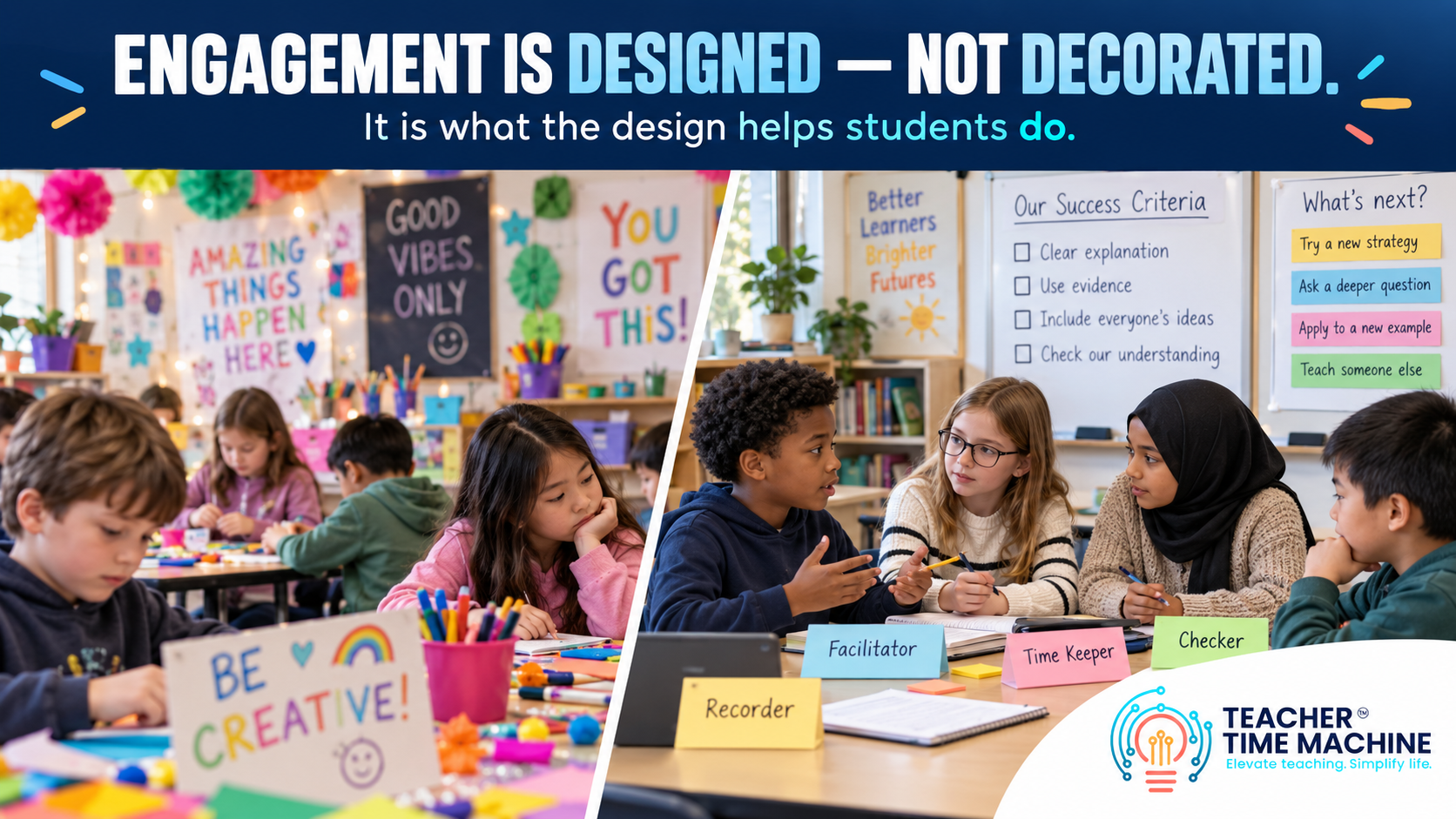
Student Engagement is Designed, Not Decorated
New research involving more than 38,000 elementary students reveals which instructional approaches show the most promise for meaningful engagement.
Engagement is not about keeping students entertained. A new meta-analysis suggests that teacher support and explicit learning strategies are among the most promising ways to help elementary students participate, persist, and take greater ownership of learning.
What does an engaging lesson look like?
It is tempting to picture colourful slides, a fast-paced game, an elaborate classroom transformation, or an activity students immediately describe as fun.
Those things can capture attention. They can create excitement. They may even help students feel positive about the lesson.
But attention is not the same as engagement—and engagement is not the same as entertainment.
A student can enjoy an activity without thinking deeply. Another can be quiet and intensely engaged in solving a difficult problem. A lesson can look busy while students remain uncertain about what they are learning, why it matters, or what to do when the work becomes challenging.
Meaningful engagement is less about how spectacular a lesson appears and more about what the design invites students to do.
Do students participate? Do they persist? Do they use strategies when they get stuck? Do they understand the purpose of the learning? Do they have opportunities to make decisions, reflect, revise, and take increasing responsibility?
A major new research synthesis offers useful guidance.
What the Research Examined
A 2026 systematic review and meta-analysis published in Educational Psychology Review examined interventions intended to improve engagement among elementary school students.
Researchers Julie Goulet, Isabelle Archambault, Christine Maltais, Ophélie Gilbert-Blanchard, and Michel Janosz analyzed 46 experimental or quasi-experimental interventions involving 38,225 students.
Importantly, the researchers did not treat engagement as one simple idea. They examined three dimensions:
- Behavioural engagement: attention, effort, persistence, participation, and remaining involved in schoolwork
- Affective engagement: emotions connected to learning, including interest, enjoyment, and boredom
- Cognitive engagement: strategies students use to organize, plan, monitor, and improve their learning
The evidence was strongest for behavioural engagement. Forty-one interventions involving more than 36,000 students measured this dimension. Far fewer examined affective engagement or cognitive engagement, so conclusions about students’ emotions and deeper learning strategies remain more tentative.
That distinction matters. The study gives us credible evidence about approaches that can strengthen students’ participation and persistence, but it does not support claiming that one strategy automatically creates every form of engagement.
Two Particularly Promising Approaches
The meta-analysis grouped interventions into teacher-support, student-directed, and multimodal approaches. All three showed positive average effects on behavioural engagement, but two findings stand out for instructional design.
1. Supporting teachers supports student engagement
Teacher-support interventions—primarily professional learning intended to improve classroom practice—showed a moderate positive effect on students’ behavioural engagement.
This is a powerful reminder that engagement is not a trait students either bring to class or fail to bring. Classroom conditions matter. The way a teacher structures learning, communicates expectations, responds to students, and adjusts instruction can make participation more achievable.
When we ask, “Why aren’t these students engaged?” we should also ask:
- Is the purpose of the learning clear?
- Is the task appropriately challenging?
- Do students know what success looks like?
- Have likely barriers been anticipated?
- Does the teacher have usable evidence about who understands and who needs another pathway?
- Can instruction be adjusted before students disengage completely?
Teacher efficacy and student engagement are not competing priorities. Helping teachers make stronger instructional decisions creates better conditions for students to engage.
2. Students benefit from being taught how to learn
Among student-directed approaches, interventions that developed learning strategies showed the largest estimated effect on behavioural engagement.
These interventions help students do more than complete a task. They build the skills needed to approach learning intentionally: planning, organizing, monitoring progress, persisting through difficulty, and reflecting on what works.
This challenges a common assumption that students become independent simply by being given more independence.
Choice without clarity can become confusion. An open-ended task without sufficient strategy instruction can privilege students who already know how to organize themselves, interpret expectations, and recover when their first attempt fails.
Agency needs architecture.
Students are more prepared to take ownership when they understand the destination, can recognize quality, have strategies available, and receive feedback that helps them choose a next step.
What This Means for Lesson Design
If engagement is a design outcome, it needs to be considered from the beginning—not added as a game after the lesson is planned.
Here are five ways to build it into the learning experience.
1. Start with a clear learning destination
Students are more able to direct effort when they understand what they are working toward. Learning intentions should describe the learning rather than simply the activity.
“Complete the poster” tells students what to produce.
“Explain how different groups can experience the same historical event from different perspectives” tells them what they are learning to do.
The poster may still be useful, but now it serves a meaningful destination.
2. Make success visible
Clear success criteria help students monitor their work instead of waiting for the teacher to judge it at the end. Examples, models, checklists, rubrics, and co-created criteria can all help students recognize quality.
This makes feedback more actionable and allows students to ask, “What is my next step?” rather than only, “What mark did I get?”
3. Teach the strategies the task requires
If students must compare, analyze, plan, investigate, revise, collaborate, or justify, we cannot assume they already know how.
Provide the thinking routine, planning tool, sentence frame, worked example, discussion structure, or self-monitoring prompt that makes the process accessible. Scaffolding is not lowering the goal. It is building a pathway toward it.
3. Use formative evidence to adjust the route
An exit ticket is not formative simply because it happens before the final assessment. It becomes formative when the evidence changes what happens next.
Teachers need quick ways to identify misconceptions, notice who is ready to move forward, and decide whether to reteach, regroup, scaffold, extend, or offer another representation.
Students can be part of this process through self-assessment, peer feedback, reflection, and goal-setting. The more clearly they understand the learning, the more meaningfully they can participate in decisions about their next steps.
4. Offer meaningful choice within a coherent design
Choice can strengthen engagement when every option remains connected to the intended outcome.
Students might choose which example to investigate, which role to take in a group, which resource to use, or how to demonstrate their learning. But the choices should not accidentally create entirely different expectations or remove essential learning.
The goal is not unlimited choice. It is purposeful flexibility.
5. Engagement and Inclusion Cannot Be Separated
When a student appears disengaged, the problem may not be a lack of interest or effort. The student may be facing a barrier in the way the learning is represented, structured, communicated, or assessed.
A reading level may block access to a concept the student could otherwise understand. A single method of response may hide what the student knows. An unstructured collaborative task may overwhelm a learner who needs clearer roles. Cultural assumptions may make a resource feel distant or unwelcoming.
Universal Design for Learning asks us to anticipate learner variability before barriers emerge. That makes it deeply connected to engagement.
Multiple ways to access information, participate in learning, and demonstrate understanding are not extras for a few students. They create more opportunities for all students to enter the learning, remain involved, and show growth.
Technology Should Strengthen the Design—not Just Decorate It
AI can quickly generate games, activities, passages, questions, and worksheets. But the speed or novelty of those materials does not guarantee engagement.
The more important questions are:
- Is the activity connected to a clear outcome?
- Does it ask students to think and make meaning?
- Does it teach or support the strategies students need?
- Can it be adapted for learner variability?
- Does it generate evidence the teacher and student can use?
- Does it lead naturally to a meaningful next step?
At Teacher Time Machine, this is why we begin with the curriculum and use backward design. We connect learning outcomes, assessment evidence, learning intentions, success criteria, formative checks, and instructional experiences so that engaging activities serve a larger purpose.
Teachers can then remix those experiences for the students in front of them—adjusting reading levels, adding scaffolding, translating materials, changing strategies, or creating different ways for students to demonstrate the same intended learning.
Eddie supports the thinking throughout the process, but the teacher remains at the centre of the decisions.
Because the goal is not to generate something that merely looks engaging.
The goal is to help teachers design learning in which students can participate, persist, think, and gradually take greater ownership.
The Better Question
Instead of asking:
Was the activity fun?
We can ask:
What did the design help students do as learners?
Did they understand the purpose? Use a strategy? Persist through challenge? Explain their thinking? Respond to feedback? Make a meaningful choice? Recognize their own next step?
That is engagement we can design for.
And it is far more powerful than keeping students busy.
Sources
Goulet, J., Archambault, I., Maltais, C., Gilbert-Blanchard, O., & Janosz, M. (2026). Promoting engagement in elementary school: A systematic review and meta-analysis of intervention effects. Educational Psychology Review, 38, Article 107.[https://link.springer.com/article/10.1007/s10648-026-10204-w]
This post was written with the help of AI
About the author

Sharon Skretting
Founder, CEO Instruction, EdTech Literacy and Assessment
Sharon has 32 years of service in Education. She has served as a classroom teacher, an instructional and assessment coach, and a principal. Her passion is helping teachers increase student engagement and ownership for learning.
Discussion
Sign in to read the discussion and join in.
Sign in