The Hidden Work Behind AI Lesson Planning—and What Actually Saves Teachers Time
AI can generate a lesson in seconds—but does it reduce teacher workload? New research reveals what meaningful time-saving instructional design requires.
The Hidden Work Behind AI Lesson Planning—and What Actually Saves Teachers Time
New research suggests that many curriculum resources and AI tools do not eliminate teachers’ planning work—they move it. Here is what meaningful time savings should look like.
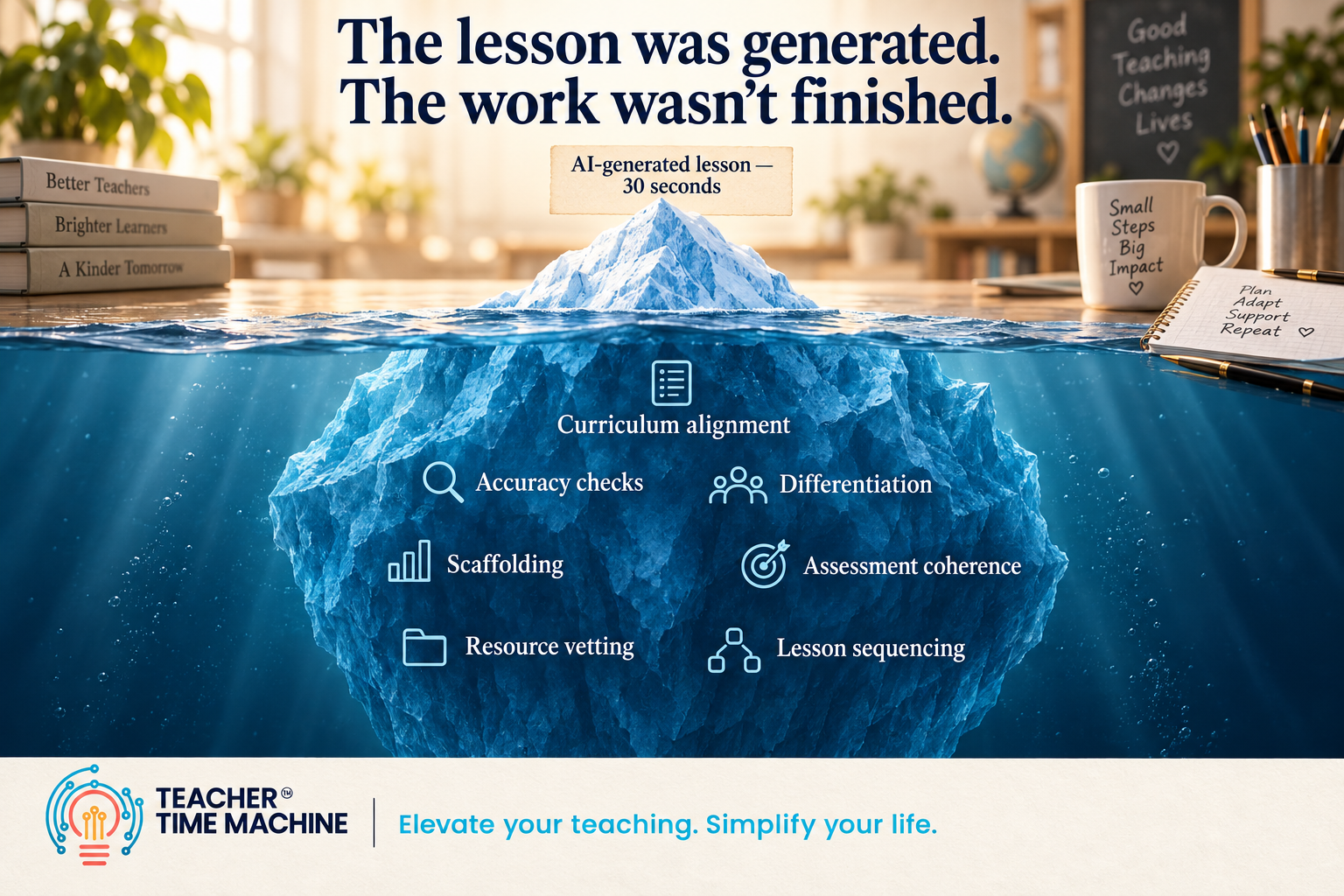
An AI tool can generate a lesson plan in seconds. That sounds like time saved. But then the teacher begins the work that happens after the button is pressed: Does this actually address the curriculum outcome? Is the content accurate and appropriate for this grade? Will this activity help students demonstrate the intended learning? What needs to change for the students who need more scaffolding? Is the reading level accessible? How will I know whether students understand? How does this lesson connect to what came before and what comes next?
Suddenly, the 30-second lesson plan requires another 30 or 45 minutes of checking, revising, aligning, adapting, and rebuilding. The lesson may have been generated quickly. The teacher’s workload has not necessarily disappeared. It may simply have moved.
What Recent Research Says About the “Time-Saving” Promise
A 2026 systematic research synthesis published in The Australian Educational Researcher examined commercial curriculum resources and their effects on teachers’ workload, with particular attention to lesson planning and preparation.
Researchers Anna Hogan, Greg Thompson, and Naomi Barnes screened 544 records and synthesized 45 peer-reviewed studies published between 2005 and 2025. The resources examined included textbooks, scripted programs, online repositories, digital platforms, curriculum marketplaces, and generative AI tools.
Their conclusion deserves attention: externally produced resources can reduce the time teachers spend creating materials from scratch, but evidence of sustained workload reduction is limited and highly dependent on how those resources are designed and used.
In many cases, the work is redistributed into less visible tasks:
• Searching for useful materials
• Evaluating quality and accuracy
• Checking curriculum alignment
• Correcting errors, omissions, or bias
• Adapting content for the students in the room
• Connecting separate resources into a coherent learning sequence
• Ensuring that instruction and assessment measure the same intended learning
The study is a systematic, interpretive synthesis rather than a meta-analysis, so it does not calculate one universal effect on teacher workload or prove that every commercial or AI resource produces the same result. However, the pattern across the literature is important: a fast resource is not automatically a usable resource, and a usable resource is not automatically the right resource for a particular class.
The Real Work Is Not Just Producing a Lesson
Teachers do far more than fill a blank page.
Meaningful instructional design begins with decisions:
• What do students need to know, understand, and be able to do? • What evidence would demonstrate that learning? • Which experiences will help students reach that goal? • What barriers could prevent some students from participating or succeeding? • What will the teacher do when formative evidence shows that students are not there yet?
That is why a polished worksheet, activity, or AI-generated plan can still create considerable work. If it begins with an interesting activity rather than the intended learning, the teacher must work backward to determine whether it belongs. If it is not connected to the curriculum, the teacher must complete the alignment. If it assumes that every student learns in the same way, the teacher must rebuild it for learner variability.
The technology produced an output. The teacher still had to perform the instructional design.
When Technology Actually Saves Teachers Time
Meaningful time savings require more than faster generation. They require a system that reduces the work surrounding the generation.
1. Curriculum alignment must be built in
Teachers should not have to copy an outcome into one tool, generate an activity in another, and then manually determine whether the two truly align. The intended outcome needs to remain visible throughout planning, instruction, and assessment. This is the foundation of backward design: begin with where students need to go, determine what evidence will demonstrate the learning, and then design the route.
2. Adaptation must be part of the workflow
No resource developer—and no AI model—knows the students in a particular classroom as well as their teacher does. Teachers need to be able to adjust reading levels, add scaffolds, translate materials, offer parallel tasks, change instructional strategies, and create different ways for students to demonstrate learning without starting over.
Customization is not evidence that a resource has failed. It is evidence that a teacher is exercising professional judgement.
3. Quality assurance cannot be left entirely to the teacher
If a tool produces content quickly but requires the teacher to verify every outcome, source, question, link, and assessment decision independently, it may create a new quality-control job rather than remove one. Platforms designed for education should provide structures that support pedagogical quality: embedded curriculum, coherent learning intentions and success criteria, assessment alignment, formative checks, appropriate depth of knowledge, and transparent opportunities for teacher review.
4. Resources must connect to a larger learning journey
Teachers rarely need one isolated activity. They need lessons that connect to units, units that connect to a year plan, and assessments that reflect the learning students were actually given opportunities to develop. A complete instructional workflow reduces the work of moving among disconnected tools and stitching unrelated outputs together.
5. Teacher agency must remain at the centre
The research also identifies a risk in highly prescriptive resources: efficiency can come at the expense of professional autonomy. Teachers should not be reduced to delivering someone else’s script. The strongest model gives them a high-quality, curriculum-aligned starting point and makes it easier to adjust that starting point for their students, context, and professional goals.
Classroom-Ready Should Not Mean “Teach It Exactly as Written”
At Teacher Time Machine, we believe the most useful resource is neither a blank page nor a rigid script. It is a strong starting point that a teacher can trust—and change. That is why our Classroom-Ready resources begin with curriculum outcomes and backward design. The learning, assessment evidence, formative checks, activities, and teacher materials are designed as a coherent experience rather than a disconnected bundle of worksheets. But we also recognize something essential: we do not know the students sitting in each classroom.
The teacher does.
Through Teacher Time Machine, educators can remix resources, adjust reading levels, add scaffolding, translate materials, change activities, create alternate ways for students to demonstrate an outcome, and use Eddie as an educationally trained planning partner. Teachers can organize that work within a course plan, schedule it, save it, and share it with colleagues rather than rebuilding alone in separate silos.
The goal is not to remove teachers from instructional design. It is to remove the repetitive, fragmented work that makes good instructional design harder to accomplish.
A Better Measure of Time Saved
The most useful question is not: How quickly did the AI produce something?
It is: How quickly did the teacher get to something accurate, aligned, inclusive, coherent, and ready for their students?
That is the time saving that matters.
Teachers do not need more rapidly generated content to sort through. They need a system that helps them make strong decisions, act on those decisions, and carry the work through from curriculum outcome to classroom execution.
Because teachers have better things to do with their time than correct the tools that were supposed to save it.
Sources Hogan, A., Thompson, G., & Barnes, N. (2026). Commercial curriculum, efficiency claims and teachers’ work: A systematic research synthesis. The Australian Educational Researcher, 53, Article 72.
About the author

Sharon Skretting
Founder, CEO Instruction, EdTech Literacy and Assessment
Sharon has 32 years of service in Education. She has served as a classroom teacher, an instructional and assessment coach, and a principal. Her passion is helping teachers increase student engagement and ownership for learning.
Discussion
Sign in to read the discussion and join in.
Sign in