AI Can Generate a Lesson. But Can It Protect the Learning?
AI can generate a lesson plan in seconds. But speed is no longer the most important question.
The more important question is whether that lesson still belongs inside a coherent learning experience.
Does it connect to the curriculum outcomes students are expected to learn? Does it build on what came before? Does the assessment actually measure the intended learning? Can the teacher adapt it for the students in front of them? And does the teacher remain the final professional decision-maker?
A new September 2026 report from EdReports, AI in K–12 Instructional Materials: What We’re Seeing, suggests that these questions should be at the centre of how schools evaluate AI-enabled instructional products.
The report does not conclude that AI improves or harms learning. Instead, it identifies a more immediate problem: AI is entering instructional materials faster than the education sector’s ability to evaluate its instructional quality.
AI is not one type of educational tool
AI is now appearing across almost every part of the instructional process. It can:
- Draft lesson plans and activities
- Differentiate passages and assignments
- Generate practice questions
- Support tutoring and feedback
- Analyze student responses
- Recommend instructional next steps
- Assist with scoring and assessment
- Automate multi-step teacher workflows
But should it? These functions are not interchangeable
An AI feature that helps a teacher adapt a reading passage before it reaches students creates different instructional and quality considerations than a student-facing tutor that changes its responses in real time. A tool that summarizes assessment data is not performing the same role as a tool that generates an entire unit.
That means the label “AI-powered” tells educators very little on its own.
To understand an AI tool’s instructional value, we need to know what it does, who uses it, what information shapes its output, where it sits within the learning process, and where professional oversight occurs.
A good resource can still be the wrong resource
One of the most important insights in the EdReports analysis is that instructional quality cannot be judged only by examining an AI-generated item in isolation.
A reading passage may be accurate and age-appropriate. A worksheet may be polished. A lesson activity may be engaging. An assessment question may be well written.
But each can still weaken learning if it sits outside the curriculum’s intended sequence, introduces ideas before students are ready, measures something other than the stated outcome, or replaces a more meaningful learning experience with disconnected practice.
This is the difference between content generation and instructional design.
Content generation asks: Is this individual resource usable?
Instructional design asks:
- Why are students learning this?
- What should they understand or be able to do?
- What evidence will demonstrate that learning?
- What experiences will prepare them to produce that evidence?
- How does this connect to previous and future learning?
- What barriers could prevent students from participating or showing what they know?
The real value of educational AI will not come from generating more materials. It will come from helping teachers protect these connections.
The lesson may be generated in seconds. Coherence still has to be designed.
The evidence gap matters
EdReports reviewed publicly available information from 10 K–12 curriculum and education-technology providers, including major publishers, mid-sized providers, and digital-first companies.
Across the market, providers commonly make claims about personalization, engagement, efficiency, teacher trust, and human oversight. However, EdReports found far less information showing how AI-generated or AI-adapted resources fit within curriculum standards, pacing, instructional sequence, and the larger learning design.
The report also raises an important evidence issue: research supporting an established educational product does not automatically validate an AI feature added to that product later.
If the feature changes what content is presented, how it is adapted, what feedback students receive, or how teachers interpret evidence, then the feature itself needs to be examined.
This does not mean AI tools have no instructional value. It means schools should distinguish between a promising capability, a marketing claim, and demonstrated evidence.
The report itself also has limits. It is a qualitative market scan based largely on public information. It does not independently test products or measure student outcomes. Its value is therefore not in proving which tools work. Its value is in identifying the questions educators and districts should now be asking.
Five questions schools should ask about instructional AI
Before adopting or expanding an AI-enabled instructional product, educators and district leaders should be able to answer five questions.
1. What instructional purpose does the AI serve?
“Uses AI” is not a pedagogical purpose. Is the feature helping teachers design instruction, remove an accessibility barrier, interpret student evidence, generate feedback, or provide student practice? The purpose should be specific enough to evaluate.
2. Which curriculum outcomes shaped the output?
A generic claim of “standards alignment” is not enough. Teachers should be able to see which outcomes informed the resource and how the activity or assessment connects to those outcomes.
3. How does the resource fit the learning sequence?
AI should not treat every lesson as an isolated event. Strong instructional materials build knowledge and skill deliberately over time. Generated resources should respect that progression.
4. What evidence or student information informed the recommendation?
If a tool recommends a scaffold, intervention, next step, or assessment judgement, educators should be able to understand what information produced that recommendation—and recognize what the system does not know.
5. Where does the teacher review, adapt, or override the output?
Teacher oversight must be more than a disclaimer telling educators to “check the work.” The workflow should make professional review practical by showing the purpose, alignment, assumptions, and consequences of the AI-generated suggestion.
Teacher-in-the-loop must mean more than final approval
It is tempting to describe human oversight as a final checkpoint: AI creates something, and the teacher approves or rejects it.
But meaningful teacher agency begins earlier.
Teachers should shape the goal, provide classroom context, select the outcomes, identify learner needs, review the design logic, and determine what happens next. Their role is not simply to correct an AI-generated product. Their professional judgement should influence the entire workflow.
This matters because teachers know things the system may not:
- What students have already experienced
- Which misconceptions are emerging
- How language, disability, culture, or background knowledge may affect participation
- Which supports preserve challenge rather than reduce it
- When a class needs more time, a different representation, or a new approach
- Whether the proposed evidence truly reflects the intended learning
- AI can organize information and surface possibilities. The teacher determines what is pedagogically appropriate.
What this means for Teacher Time Machine
The EdReports analysis reinforces the importance of building AI around instructional design rather than adding instructional language around a generic AI generator.
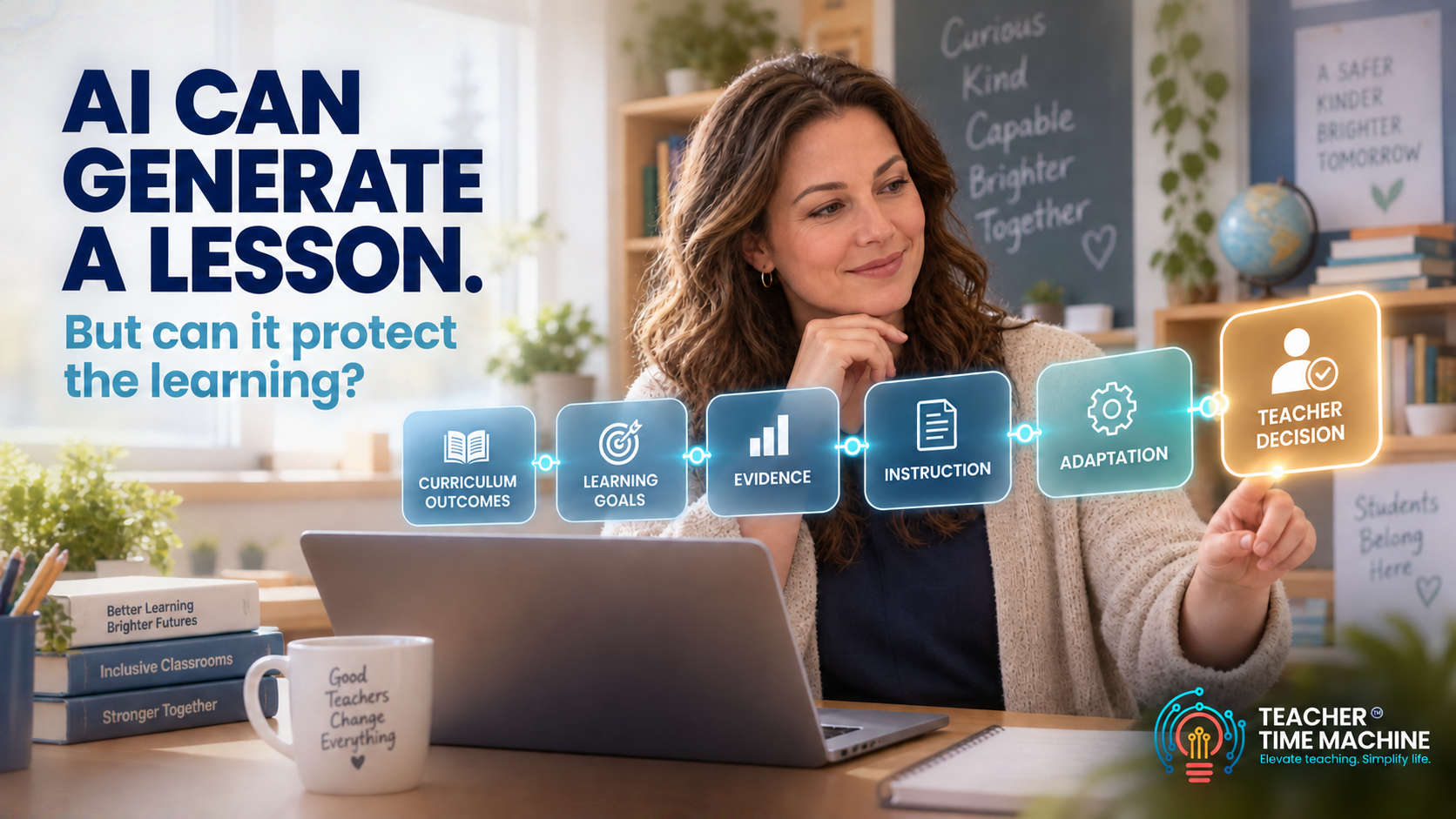
Teacher Time Machine begins with embedded curriculum and a backward-design workflow. Outcomes inform the learning goals. Learning goals inform the evidence. Evidence informs instruction. Class context informs adaptation. The teacher can then review, edit, remix, and decide what reaches students.
The next opportunity is to make that reasoning even more visible.

When Eddie recommends a resource, adaptation, formative response, or instructional next step, teachers should be able to see:
- The instructional purpose
- The curriculum connection
- The evidence or class context that shaped the suggestion
- The assumptions that may need teacher confirmation
- Alternative options
- The point at which the teacher makes the final decision
This is not about burdening teachers with more information. It is about making review faster, more focused, and more professionally meaningful.
The next measure of AI quality
The first generation of educational AI was judged largely by speed: How quickly could it create a lesson, passage, rubric, or quiz?
We stand by what we've said from the beginning. The next generation should be judged by a more demanding standard:
Does the AI system help teachers create a coherent, curriculum-aligned, inclusive learning experience while strengthening—not bypassing—their professional judgement?
AI can generate instructional material.
The real test is whether it can help protect the learning.
Sources
EdReports. (2026). AI in K–12 Instructional Materials: What We’re Seeing—A Market Baseline and Emerging Questions for Curriculum Quality. September 2026.
About the author

Sharon Skretting
Founder, CEO Instruction, EdTech Literacy and Assessment
Sharon has 32 years of service in Education. She has served as a classroom teacher, an instructional and assessment coach, and a principal. Her passion is helping teachers increase student engagement and ownership for learning.
Discussion
Sign in to read the discussion and join in.
Sign in